
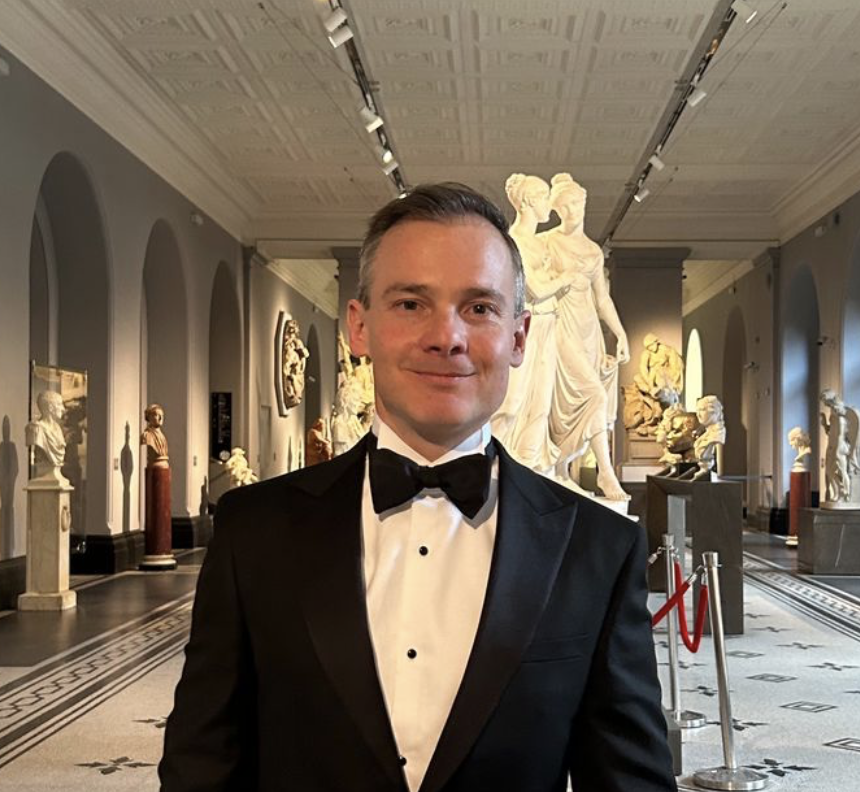
Louis was awarded the National Bank of Canada Scholarship 2024-2025. His profile is also available in French (see below).
A French-speaking native of the province of Québec, Louis is a doctoral student in law at the University of Cambridge (Clare Hall), where he is pursuing research in comparative immigration law and legal philosophy. By comparing the immigration systems of Canada and the UK, which share a common legal tradition but face very different geopolitical issues, his aim is to better understand the legal implications of the use of the notion of compassion in the administrative processing of applications from foreign nationals.
Louis originally trained in philosophy at the Université du Québec à Montréal. He holds a BA and MA in this discipline. His master’s thesis focused on the philosophical foundations of the right to freedom of conscience in the context of religious conflict. This work showed that the role of feelings towards others can be decisive in the interpretation of this right.
Before turning to law, he taught philosophy for 10 years at a public post-secondary institution near Montréal. While a philosophy teacher, partner and father of three children, Louis began studying law at the Université du Québec à Montréal to become a law professor and legal counsel. After obtaining his LLB and becoming a member of the Québec Bar, he served as law clerk at the Québec Court of Appeal for two years, where he was paired with the Honourable Yves-Marie Morissette, JA. He then clerked for a year at the Supreme Court of Canada for the Right Honourable Richard Wagner, PC., Chief Justice of Canada.
His interest in compassion in immigration law grew out of a deeper reflection on the role of emotions in administrative law, his primary field of interest, combined with the philosophy of law – particularly, the study of the indeterminacy of the law. Canadian and UK immigration law make explicit reference to the notion of compassion which therefore becomes a legal norm to which immigration officers must refer in their decisions.
The question of the relationship between this notion and the traditional approach to the law based on impartial, reliable and consistent decision-making seems at first sight to pose a contradiction. Louis’s doctoral project, funded by SSHRC, aims to elucidate this so as to provide clearer guidance to applicants, administrative decision-makers, and judges who need to interpret ‘compassion’ as a legal norm in Canadian or UK immigration law.
The results of his PhD research also aim to provide insight into the general role of emotions in other fields of law such as health law or criminal law.
Francophone et originaire du Québec, Louis est doctorant en droit à l’Université de Cambridge (Clare Hall), là où il poursuit des recherches en droit comparé de l’immigration et en philosophie du droit. En comparant les systèmes d’immigration du Canada et du Royaume-Uni, deux pays partageant une tradition juridique commune mais confrontés à des enjeux géopolitiques fort différents, son objectif est de mieux comprendre les implications juridiques du recours à la notion de compassion dans le traitement administratif des demandes introduites par les étrangers.
Louis a d’abord été formé en philosophie à l’Université du Québec à Montréal (UQAM). Il est détenteur d’un baccalauréat et d’une maîtrise dans cette discipline. Son mémoire a porté sur les fondements philosophiques du droit à la liberté de conscience en contexte de conflits religieux, où il a démontré que le rôle des sentiments envers l’autre influence la façon d’interpréter ce droit.
Avant de se tourner vers le droit, il a enseigné la philosophie pendant dix ans dans une institution publique postsecondaire. Alors qu’il était professeur, conjoint et père de trois enfants, Louis a entamé ses études en droit à l’UQAM, dans le but d’enseigner et de pratiquer dans ce domaine. Une fois son baccalauréat en droit obtenu, il est devenu membre du Barreau du Québec et a travaillé deux années à la Cour d’appel du Québec en tant qu’avocat-recherchiste auprès de la magistrature, où il a été jumelé avec l’honorable Yves-Marie Morissette, j.c.a. Par la suite, au cours d’une année, il a été auxiliaire juridique à la Cour suprême du Canada auprès du très honorable Richard Wagner, C.P., juge en chef du Canada.
Son intérêt pour la compassion en droit est né d’une réflexion plus approfondie sur le rôle des émotions en droit administratif, son principal champ d’intérêt, combiné à celui de la philosophie du droit – et plus particulièrement l’étude de concepts indéterminés. Au Canada et au Royaume-Uni, il est référé explicitement en droit de l’immigration à la notion de compassion, qui devient alors une norme juridique à laquelle les agents d’immigration doivent se référer. La question du rapport entre cette notion et l’approche traditionnelle du droit fondée sur l’exercice décisionnel impartial, fiable et constant soulève à première vue une contradiction.
Le projet doctoral de Louis, subventionné par une bourse doctorale du Conseil de recherche de recherches en sciences humaines du Canada, vise à élucider cette question, et ce, dans le but d’offrir des balises plus claires aux demandeurs, aux décideurs administratifs ainsi qu’aux juges ayant à interpréter la notion de compassion en droit de l’immigration canadien ou britannique.
Plus généralement, sa recherche vise aussi à fournir des clés interprétatives sur le rôle des émotions dans d’autres domaines, tels que le droit de la santé ou le droit criminel.
